Rome Catacomb Tours
Tours & tickets

Hand-picked by our editors — only the best 5 experiences from 18 reviewed.

Open today 09:00–12:00, 14:00–17:00
Attendance: Moderate — autumn season
Please arrive at least 10 minutes before your scheduled tour time.
Skip-the-line Instant confirmation Free cancellation Mobile voucher Verified partner
Tickets

Choose your ticket

Verified partners for every tour, free cancellation where available, and instant confirmation on every booking.

St. Callixtus Catacombs Guided Tour 30 min
Guided Experience

St. Callixtus Catacombs Guided Tour

★ 4.6 (3730)
€14
per person
Instant Mobile voucher Flexible — change up to 24h

Venture beneath the Appian Way to explore one of Rome's most extensive early Christian burial networks

Reserve
Underground Catacombs Tour with Bus Transfer 2 hr
Standard Entry

Underground Catacombs Tour with Bus Transfer

★ 4.3 (2312)
€49
per person
Instant Mobile voucher Flexible — change up to 24h

Journey beneath Rome's streets to explore 2,000-year-old Christian burial tunnels with expert-led commentary

Reserve

Prices from verified partners. Availability updates in real time at checkout. Free cancellation policies apply where shown.

Highlights

What you'll see inside the attraction

The landmarks, rooms, and views travelers on this tour remember — all visible on a single visit.

Crypt of the Popes

Known as the 'little Vatican', this crypt houses the remains of nine popes and eight third-century bishops.

Head to head

St. Callixtus vs. St. Sebastian: Choosing Your Rome Underground Tours Experience

St. Callixtus offers a broader look at ancient burial galleries, whereas St. Sebastian provides a more intimate encounter with specific historical excavations; choosing the right rome underground tours depends on your interest in scale versus archaeological depth.

Feature Top pick Catacombs of St. Callixtus Catacombs of St. Sebastian
Primary draw
Early Christian mausoleums
Underground layout
Concentrated vertical shafts
Typical crowd levels
Moderate foot traffic
Guided access requirements
Mandatory guided entry
Entry fee
10 EUR
Best arrival window
09:00–17:00

Verdict: If you seek the most comprehensive subterranean rome underground tours tickets provide for scale, prioritize St. Callixtus, while those preferring smaller, concentrated ancient sites should select the rome underground tours tour at St. Sebastian.

How your ticket works

Book your ticket in 3 steps

  1. 01

    Book online

    Choose your ticket, select your date, and reserve in under two minutes. Secure checkout handled by our verified partner.

  2. 02

    Receive your mobile voucher

    Instant confirmation by email, with a mobile voucher you can save offline. No printing, no queuing at a collection desk.

  3. 03

    Show & enter

    Arrive at the entrance, show your voucher on your phone, and walk in. Most tickets include priority or skip-the-line access.

Plan your visit

Everything you need to know before you go

Practical details for your visit straight from our verified partners — hours, access, rules, and how to get there.

Open today · 09:00–12:00, 14:00–17:00
Opening Hours
09:00–12:00, 14:00–17:00
Address
Via Appia Antica, 110, 00179 Roma RM, Italy
Accessibility
Not accessible for wheelchairs
Best arrival
09:00–16:50
Storage
No large bags permitted
Contact
+39 06 513 01 51
Mon
09:00–12:00, 14:00–17:00
Tue
09:00–12:00, 14:00–17:00
Wed
Closed
Weekly closure
Thu
09:00–12:00, 14:00–17:00
Fri
09:00–12:00, 14:00–17:00
Sat
09:00–12:00, 14:00–17:00
Sun
09:00–12:00, 14:00–17:00
Closed on: Wed (Weekly closure), Jan 1 (New Year's Day), Dec 25 (Christmas Day)
Location

Address
Via Appia Antica, 110, 00179 Roma RM, Italy
Storage
No large bags permitted
Contact
+39 06 513 01 51

Dress code

As a sacred site, modest attire is required for rome underground tours. Ensure that shoulders, midriffs, and knees are covered, regardless of the outside temperature.

Bags & security

Large bags, strollers, and bulky items are strictly prohibited inside the Catacombs of Rome. Security checks may be conducted upon exit.

Photography

Photography and video recording are strictly forbidden inside the tunnels to preserve the sanctity of this historic site. This rule is enforced to protect the delicate frescoes.

Accessibility

The site is not wheelchair accessible due to 50 irregular steps and uneven, narrow underground paths. Visitors with significant mobility challenges should exercise caution when booking rome underground tours.

What to bring

  • Comfortable closed shoes
  • Light jacket
  • Water bottle (for after)
  • Printed voucher
  • Valid ID
  • Smartphone for mobile tickets

Not allowed

  • Strollers
  • Musical instruments
  • Large luggage
  • Pets
  • Tripods
  • Selfie sticks
  • Food
  • Drinks
  • Banners
  • Professional recording equipment

Families & strollers

Families are welcome, though the dark, narrow environment may not be suitable for very young children. There is no minimum age, but children must remain with their group throughout the tour.

Food & drink

Consumption of food and liquids is strictly forbidden inside the catacombs. We recommend staying hydrated before your tour begins.

Around your visit

Everything else worth knowing

Best time to go, insider tips, nearby landmarks, and the cancellation fine print — flip through to skim what matters to you.

Cancellation policy

Flexible, no hidden fees.

Purchased tickets for rome underground tours are non-refundable. Please ensure your schedule aligns with the selected slot before completing your transaction.

About

The place, in context

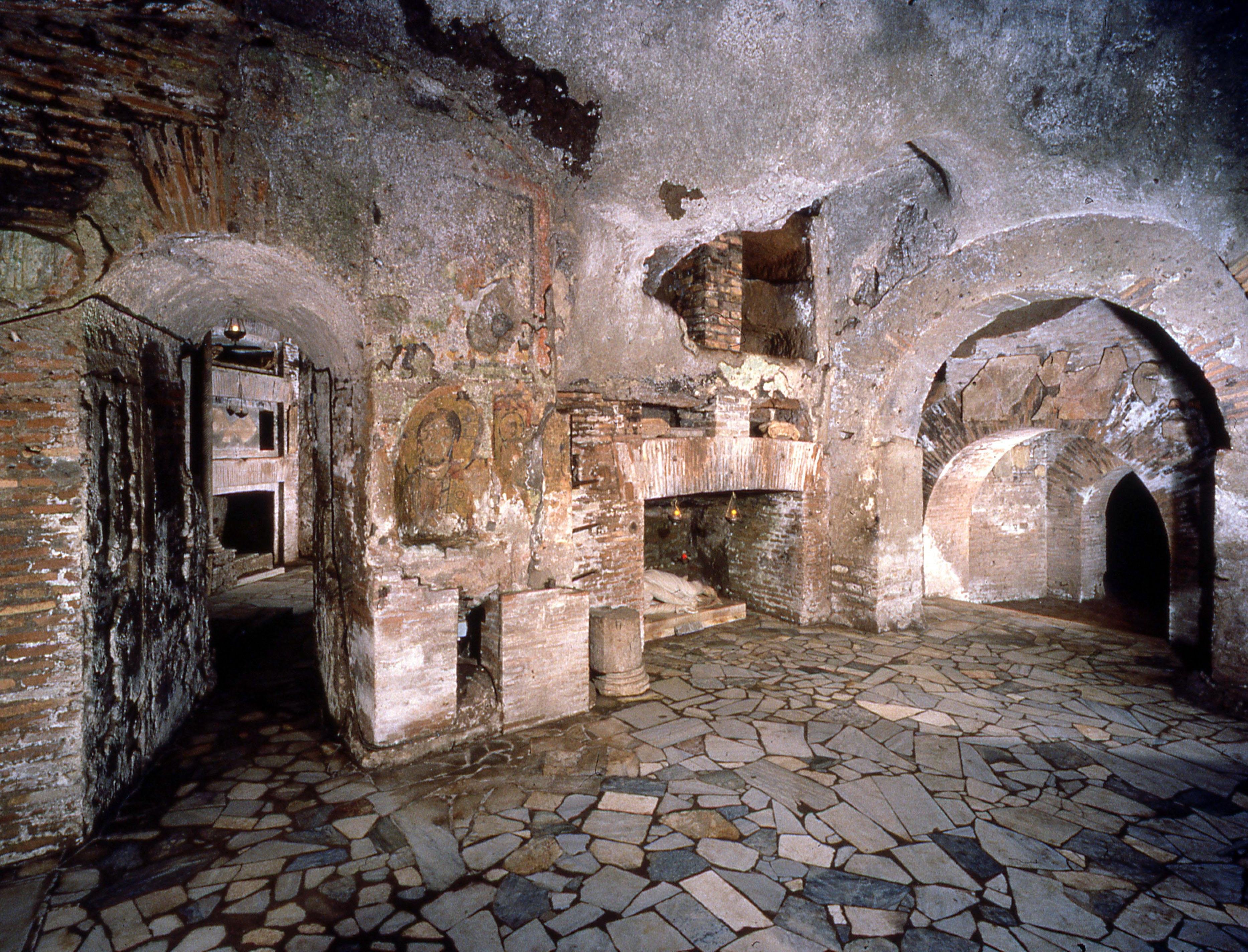
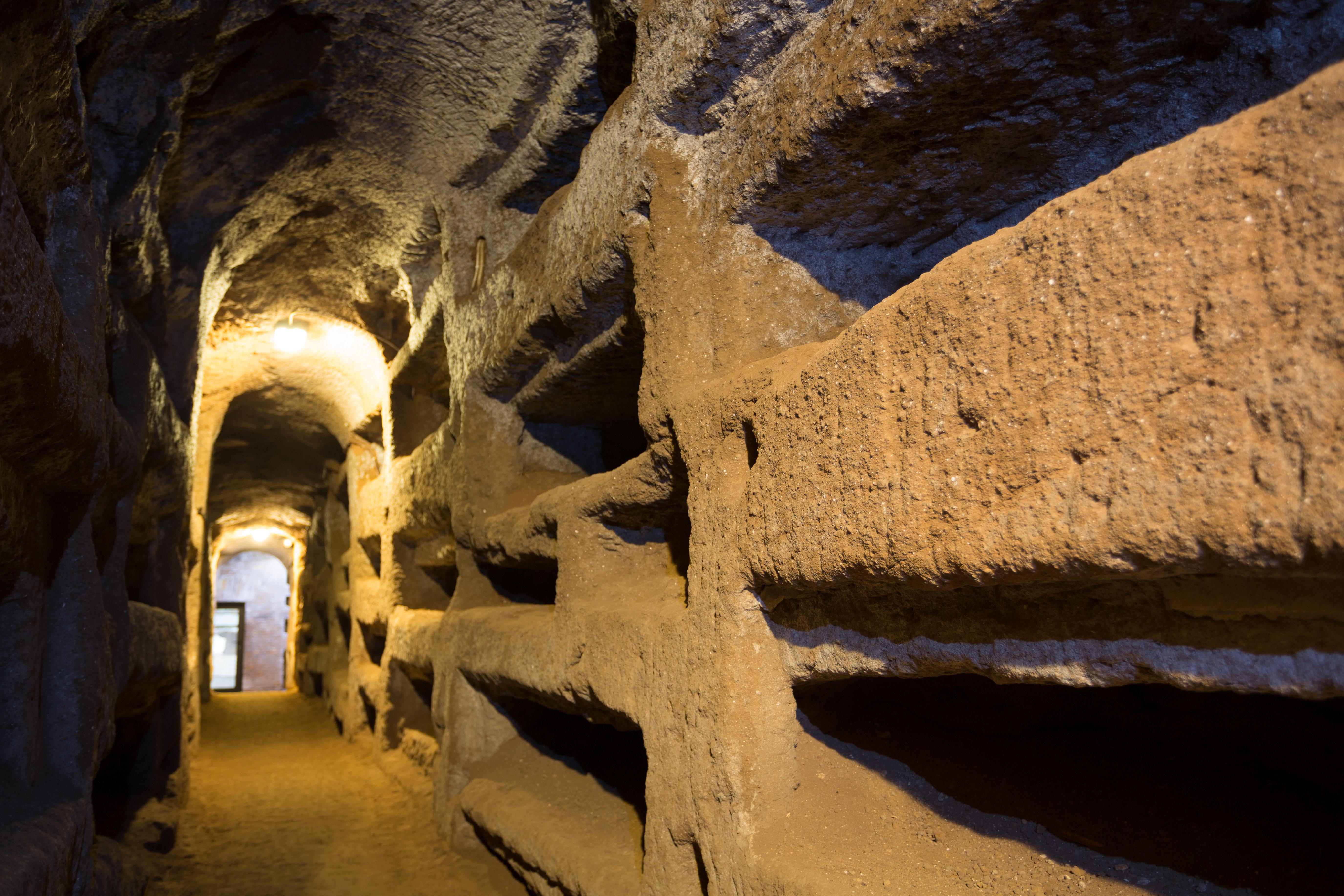
Forty kilometres of tunnels spiral beneath the Via Appia Antica, holding half a million burials carved into tufa between the second and fifth centuries. The Catacombs of San Callisto alone shelter sixteen popes and dozens of martyrs, their loculi stacked four deep along corridors that drop three storeys below the Roman countryside. Early Christians excavated these networks not as hiding places — persecution was sporadic, not continuous — but as communal necropolises where the faithful could gather for anniversary rites without the expense of surface land. The soft volcanic stone allowed rapid expansion, and by the fourth century Rome's suburban roads were honeycombed with subterranean cemeteries, each managed by a different Christian community or funerary guild. Today the catacombs remain among the most intact witnesses to early Christian life, their frescoes and inscriptions preserving a theological vocabulary still forming when Constantine legalised the faith. The oldest images — a fish, an anchor, a shepherd — predate the cross as the dominant symbol, and the Greek epitaphs outnumber Latin ones in the earliest galleries, evidence of a congregation still weighted toward the eastern Mediterranean. Wall paintings in the Cubiculum of the Sacraments depict baptism, Eucharist, and resurrection in a visual grammar that would calcify into iconographic convention only centuries later. The catacombs were abandoned by the sixth century, their relics translated to basilicas within the city walls, and the tunnels lay forgotten until Antonio Bosio began systematic exploration in the 1590s. Nineteenth-century archaeologist Giovanni Battista de Rossi mapped San Callisto's papal crypt, recovering inscriptions that anchored the legendary bishops to historical ground. Rome underground tours navigate a fraction of the total network — most galleries remain closed to preserve the frescoes and prevent structural collapse — but the accessible sections convey the scale and intimacy of early Christian devotion. The Catacombs of San Callisto open daily except Wednesday, with guided visits required to enter the underground chambers. Standard admission is ten euros, and the site lies three kilometres south of the Aurelian Walls along the ancient consular road. Morning slots between nine and noon offer cooler temperatures and thinner crowds, and the last entry closes at five in the afternoon, leaving an hour before the site shuts at six. The tour descends through three levels, passing papal tombs and the crypt of Saint Cecilia before surfacing near the basilica that marks the original entrance. No photography is permitted below ground, a rule enforced to slow the bleaching effect of camera flashes on pigment that has survived sixteen centuries in darkness.

"Forty kilometres of tunnels spiral beneath the Via Appia Antica, holding half a million burials carved into tufa between the second and fifth centuries."
Your experience

What a tour day looks like

A step-by-step walkthrough of the visit — what you'll see, how long each stage takes, and the details that matter.

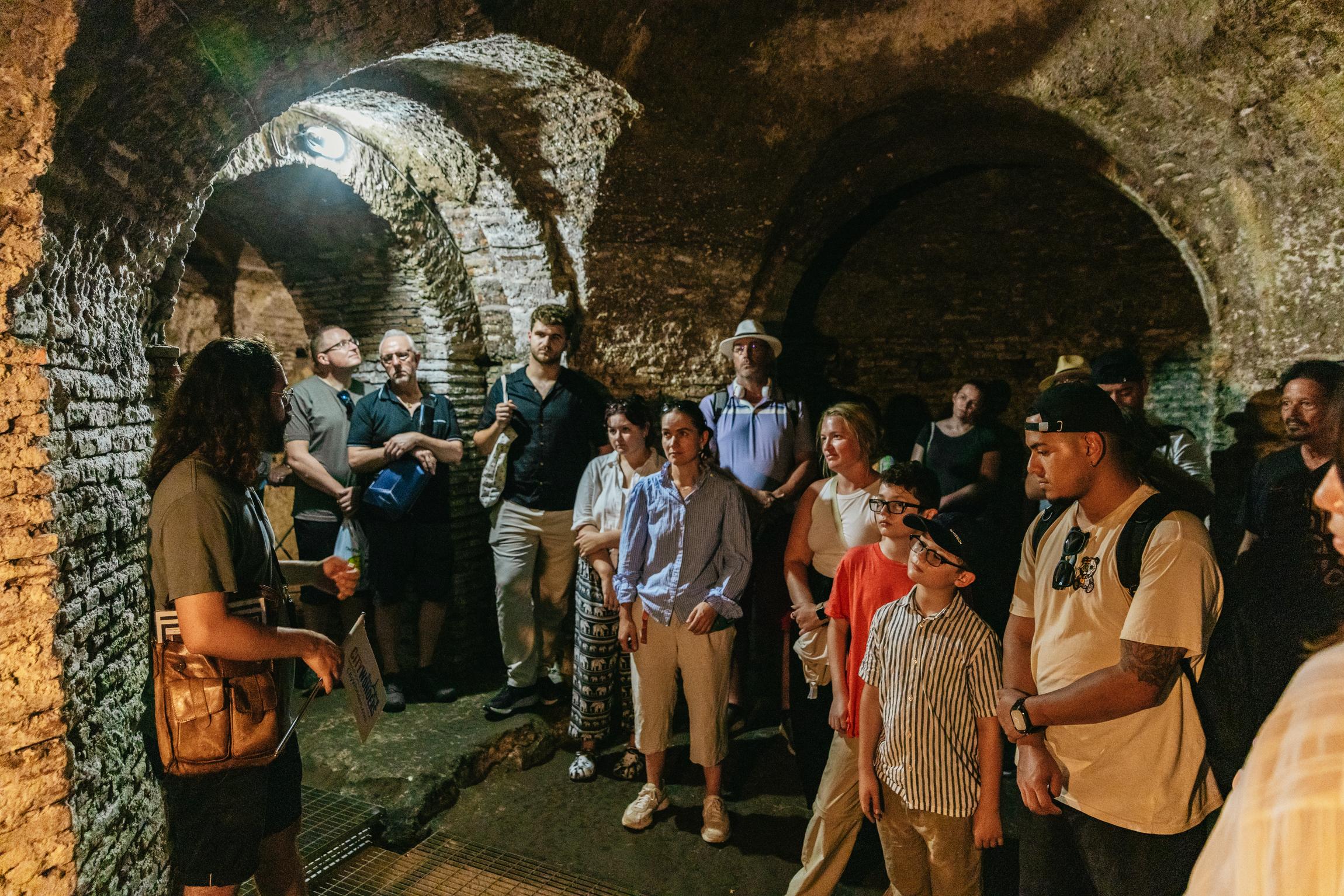
You meet your guide at the Via Appia Antica entrance, where a gravel path leads past umbrella pines to the modern visitor pavilion. After a brief orientation above ground — the guide explains the catacombs' structure, the difference between loculi and cubicula, the reasons photography damages frescoes — you descend a concrete staircase retrofitted in the 1950s, trading September heat for the constant fourteen-degree chill of the tunnels. Electric bulbs replace the oil lamps that lit ancient funeral processions, but the tufa walls still bear soot stains from those flames. The first gallery is narrow, barely wide enough for two visitors to pass, its walls pierced by hundreds of rectangular graves sealed with terracotta tiles or marble slabs. Your guide pauses at a loculus whose inscription — in Greek, not Latin — names a child who lived three years and eight months. Deeper in, you enter the papal crypt, where nine third-century bishops were buried in a single chamber, their names incised in Damasian script by order of Pope Damasus I. The adjoining cubiculum holds a fresco of the Good Shepherd, his tunic ochre, his lamb white against a blue ground that has faded to gray. The tour loops back through the Cubiculum of the Sacraments, where five scenes of baptism and Eucharist unfold across the vaulted ceiling, then climbs a second staircase to the surface. The entire circuit takes forty minutes, and you emerge blinking into daylight near the basilica, the modern city invisible beyond the cypresses.

Frequently asked

Frequently asked questions about rome underground tours tickets

Are rome underground tours available every day?

The Catacombs of Rome are open every day except Wednesday.

How much are the standard rome underground tours tickets?

Standard admission fee is 10 EUR per person.

Can I explore the Catacombs of Rome on my own?

No, all visitors must be accompanied by an official guide during their Catacombs of Rome visit.

What should I wear for my rome underground tours experience?

Wear modest clothing that covers your shoulders and knees, and bring a light jacket as the temperature underground is a constant 16°C.

Is there a dress code for rome underground tours?

Yes, as a religious site, modest attire is required for all rome underground tours participants.

Are there age restrictions for these rome underground tours?

There are no formal age restrictions for rome underground tours, though the uneven terrain may be difficult for very young children.

Can I take photos during my rome underground tours tour?

No, photography is prohibited during all rome underground tours to protect the ancient frescoes.

Is the site accessible for guests with mobility issues?

The Catacombs of Rome are not accessible to wheelchairs or those with significant mobility issues due to steep, irregular steps.

What is the best time to arrive for rome underground tours?

We recommend arriving between 09:00–16:50 for the best experience.

Are there nearby attractions to visit after my rome underground tours tour?

Yes, you can visit the Appian Way or the nearby Basilica of San Sebastiano after your rome underground tours.